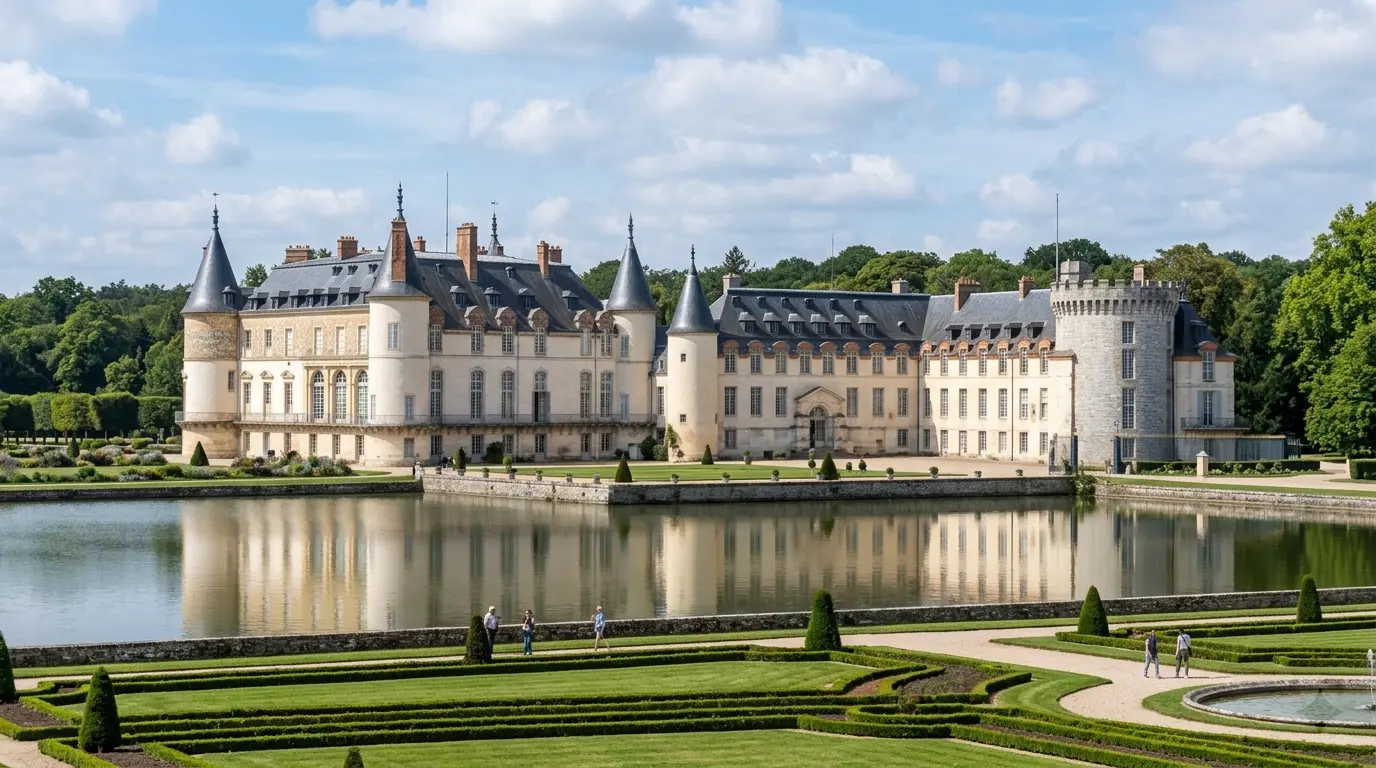
The Royal Retreat the Crowds Haven’t Discovered
While Versailles dazzles with its grandeur, there’s another royal château just 50 kilometers from Paris that offers something equally precious, intimacy with French history without the overwhelming crowds. The Château de Rambouillet is where France’s presidents welcome world leaders, where kings once hunted in vast forests, and where you can experience royal magnificence at a human scale.
A Palace That Chose Privacy Over Pomp
Rambouillet has always been different. Built in the 14th century as a fortified manor, it evolved into a royal residence favored precisely because it wasn’t Versailles. Kings came here not to impress, but to breathe—to hunt, to escape court politics, to live almost normally. Louis XVI purchased it in 1783 for Marie Antoinette (though she famously disliked it), and Napoleon made it his summer retreat.
Today, Rambouillet serves as one of the official summer residences of French presidents. This living heritage means the château isn’t frozen in time, it’s still part of France’s story, hosting diplomatic summits and state visits. You’re not just visiting history; you’re walking halls where contemporary decisions are made.
Architectural Intimacy Meets Royal Elegance
Unlike Versailles’s overwhelming scale, Rambouillet charms through proportion and detail. The château’s medieval tower grounds the ensemble, while 18th-century additions created elegant apartments that feel almost livable—at least by royal standards.
The Napoleon Apartments showcase Empire style at its finest: rich fabrics, classical motifs, and furniture that Bonaparte himself used. The Marble Bathroom, created for Napoleon, demonstrates early 19th-century luxury with stunning craftsmanship that rivals anything at Versailles.
Marie Antoinette’s Dairy (Laiterie de la Reine) deserves special mention. Designed by architect Jacques-Jean Thévenin, this neoclassical fantasy allowed the queen to play at being a shepherdess in an exquisitely decorated setting. The marble sculptures and refined details make it one of the most photographed spots on the grounds, a perfect example of 18th-century aristocratic escapism.
The Seashell Cottage (Chaumière des Coquillages) takes whimsy even further. Its interior walls are entirely covered in shells and mother-of-pearl, creating a grotto-like space that feels like stepping into a jewel box. This extraordinary folly shows the playful side of royal life.
The Forest: Where Kings Hunted and Nature Reigns
The true soul of Rambouillet lies beyond the château walls. The Rambouillet Forest stretches across 20,000 hectares—one of the largest and most beautiful forests near Paris. Ancient oaks tower overhead, creating cathedral-like spaces where light filters through leaves in golden shafts.
Louis XVI redesigned much of the park in the English style, creating romantic landscapes with winding paths, hidden ponds, and carefully composed views. Unlike Versailles’s geometric precision, Rambouillet’s park invites wandering and discovery.
The forest trails offer everything from short strolls to serious hikes. Deer roam freely (descendants of the royal hunting grounds), and in autumn, the changing leaves create a spectacular display. It’s not unusual to walk for half an hour without encountering another soul—a rare gift so close to Paris.
The Bergerie Nationale: A Living Tradition
Don’t miss the National Sheepfold (Bergerie Nationale), established by Louis XVI in 1786. This working farm continues its mission of agricultural innovation while welcoming visitors. You can meet the famous Rambouillet Merino sheep (yes, the breed originated here), watch sheepdog demonstrations, and connect with a rural tradition that still thrives.
On weekends, the farm market offers local products, cheese, wool, honey, grounding your royal visit in authentic French countryside culture.
Why Rambouillet Might Be Your Perfect Versailles Alternative
If you appreciate:
- History without the overwhelm of massive crowds
- Time to actually absorb what you’re seeing
- Nature and walking trails integrated with cultural visits
- Seeing how French presidents still use royal heritage
- Discovering something your friends back home probably haven’t heard of
Then Rambouillet delivers.
The château takes about 90 minutes to tour properly, leaving plenty of time for the park, the follies, and a peaceful lunch. You’ll leave feeling you’ve discovered something special rather than checked off a tourist box.
Practical Details for Your Visit
- Less crowded than Versailles: Even in high season, you can enjoy rooms without fighting through tour groups
- Open Wednesday through Sunday: Closed Monday and Tuesday
- Guided tours available: Often in smaller groups than Versailles
- The park is free: Perfect for a picnic before or after your château visit
- Excellent for photography: Without crowds in every frame
- Combine with the forest: Make it a full day of culture and nature
The Seasonal Experience
Each season brings its character to Rambouillet. Spring fills the park with blossoms and the forest with wildflowers. Summer offers perfect picnic weather and long evening light. Autumn transforms the forest into a golden wonderland—arguably the most beautiful season. Even winter has its charm, with the château’s interiors feeling particularly cozy and the forest paths offering crisp, solitary walks.
A Different Kind of Royal Experience
Rambouillet proves that French royal heritage isn’t just about superlatives. Where Versailles proclaims power, Rambouillet whispers refinement. Where one overwhelms, the other invites. Both tell essential chapters of French history, but Rambouillet lets you read at your own pace.
For travelers who want to understand France beyond the guidebook highlights, who appreciate discovery over celebrity attractions, Rambouillet offers something increasingly rare—a genuine experience of beauty, history, and nature without the circus of mass tourism.
It’s the château that reminds us why kings came to France not just to rule, but to live.