Château de la Madeleine & Chevreuse: Medieval Majesty Meets Village Charm
Perched on a rocky outcrop above one of France’s most enchanting valley towns, the Château de la Madeleine stands as a sentinel of history. But this isn’t just about castle ruins and panoramic views—though both are spectacular. This is about discovering a place where medieval fortifications meet living French village culture, where thousand-year-old stones tower over bustling market squares, and where authentic small-town France unfolds exactly as you’ve imagined it.
The Château: A Fortress with a View That Conquered Kings
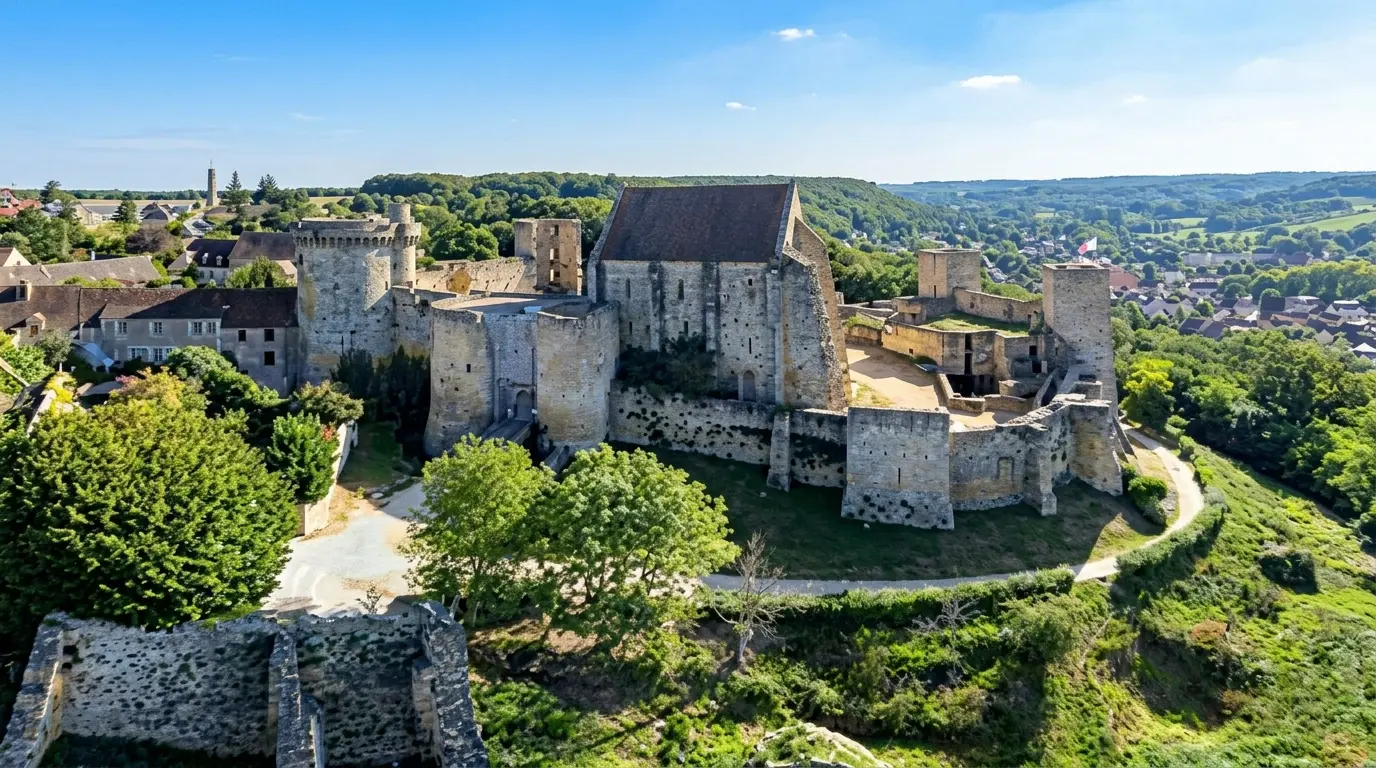
The Château de la Madeleine doesn’t overwhelm with opulence like Versailles or charm with fairy tales like Breteuil. Instead, it does something more primal—it commands. Built in the 11th century to control the Chevreuse Valley, this medieval fortress occupies one of the most strategically brilliant locations in the Île-de-France region.
The castle’s keep and ramparts rise from natural rock formations, creating an ensemble where human construction and geology become inseparable. Walking the defensive walls, you understand immediately why this site mattered: whoever controlled this height controlled the valley, its trade routes, and its people.
The Panoramic Revelation
But military strategy becomes secondary the moment you reach the panoramic viewpoint. From the château’s heights, the entire Chevreuse Valley spreads before you like a living medieval tapestry. The Yvette River winds through the valley floor, reflecting sky and trees. Red-tiled roofs of Chevreuse cluster below. Beyond, the valley extends in layers of green—forests, fields, and distant hills creating depth that shifts with the light.
This view alone justifies the visit. Photographers arrive for golden hour, when the setting sun transforms the valley into warm amber tones. Hikers come after morning climbs through surrounding forests. Couples discover it’s one of the most romantic viewpoints near Paris. Everyone leaves understanding why humans have valued this spot for a millennium.
Medieval Life Reconstructed
Unlike many ruined castles, La Madeleine has been carefully restored and interpreted. The exhibition spaces within the fortress explain medieval life with engaging displays—how the castle functioned defensively, how its inhabitants lived, what they ate, how they survived sieges.
Period reconstructions show medieval crafts and daily activities. During special events, the castle hosts medieval festivals with costumed reenactors, period music, and demonstrations of forgotten skills. These events transform the ruins from historical artifact into living memory.
The defensive architecture remains impressively intact. Walk the ramparts and you’ll follow the exact paths guards patrolled 900 years ago. Peer through arrow slits designed for archers. Stand in towers where watchmen scanned the valley for approaching threats. The castle doesn’t just display history—it lets you inhabit it.
The Town of Chevreuse: Where French Village Life Thrives
Descend from the castle into Chevreuse town and you enter a different but equally compelling world—one where medieval heritage blends seamlessly with contemporary French village life.
Architectural Time Travel
Chevreuse’s old town rewards wandering. Narrow streets wind between buildings dating from the 15th to 18th centuries. Half-timbered houses lean companionably against stone neighbors. Hidden courtyards reveal themselves to curious explorers. Each turn offers photo opportunities that capture quintessential French village character.
The Church of Saint-Saturnin, dating from the 12th century, anchors the town with Romanesque solidity. Its bell tower has marked hours for eight centuries, creating continuity that modern life increasingly lacks.
Ancient bridges cross the Yvette River at multiple points, some dating to medieval times when controlling river crossings meant controlling commerce. Today they’re perfect spots to pause and watch the water flow—a meditative counterpoint to urban rushing.
Markets, Cafés, and Real French Life
What makes Chevreuse special isn’t frozen-in-time preservation—it’s that people actually live here, creating authentic village culture you can witness and join.
The weekly market (check current days) transforms the main square into a celebration of regional products. Local farmers sell vegetables that grew in valley soil. Cheese makers offer samples of productions you won’t find in supermarkets. Bakers display breads and pastries that follow recipes perfected over generations. It’s not a tourist attraction—it’s where Chevreuse residents shop, making it all the more genuine.
Cafés and brasseries lining the main streets serve as social hubs. Sit at a terrace with café crème and watch French village life unfold: neighbors greeting each other, shopkeepers chatting with regulars, elderly residents taking their constitutionals, children heading to school. This is the France that exists beyond tourist circuits—and it’s completely accessible.
Small shops—a butcher, a baker, a wine merchant—maintain traditions of specialized commerce. Buying a baguette becomes a cultural exchange when the baker asks whether you prefer it well-done or soft, crusty or tender. These small interactions reveal French culture more authentically than any museum.
Riverside Walks and Natural Beauty
The Yvette River provides a green corridor through town. Riverside paths offer peaceful walks under dappled shade, past old mills, and through parks where locals walk dogs and children play. In summer, the water’s gentle sound creates natural air conditioning. In autumn, fallen leaves carpet the paths in gold and amber.
The Promenade des Petits Ponts (Walk of Little Bridges) connects multiple river crossings, creating a circular route that shows different perspectives on the town. It’s a perfect after-lunch stroll, the kind of gentle exercise that feels restorative rather than dutiful.
The Perfect Pairing: Castle + Town
What makes this destination exceptional is experiencing both elements together. The combination creates a complete picture of how French communities developed around defensive positions, and how those medieval foundations continue shaping contemporary life.
Morning at the château provides historical context and spectacular views. You understand the valley’s strategic importance, appreciate the defensive genius of medieval builders, and capture photographs that will make friends jealous.
Afternoon in town grounds that history in living culture. You eat lunch in restaurants housed in centuries-old buildings. You shop in markets that have occupied the same squares for hundreds of years. You witness how heritage and daily life interweave naturally rather than existing as separate museum and town.
Seasonal Transformations
Each season rewrites Chevreuse’s character:
Spring brings the valley to exuberant life—wildflowers on the castle approaches, market stalls overflowing with asparagus and strawberries, café terraces filling with locals emerging from winter hibernation.
Summer offers long, warm evenings perfect for riverside walks and outdoor dining. Medieval festivals often take place during these months, adding theatrical dimension to your visit.
Autumn paints the valley in spectacular colors visible from the château heights. The harvest season means markets brim with apples, mushrooms, game, and the first winter vegetables. The slanting light creates photographer’s paradise.
Winter strips away decoration to reveal architectural bones. The castle becomes dramatically stark against gray skies. The town’s cafés offer cozy refuge with hot chocolate and warming stews. It’s intimate and authentic—tourists thin out, but local life continues unabated.
Why Chevreuse Matters
In a region dominated by grand châteaux and royal palaces, Chevreuse offers something equally valuable—authenticity at human scale. The castle isn’t the biggest or most opulent, but its position and views rival anything in France. The town isn’t a preserved theme park, but a living community that maintains traditions while embracing contemporary life.
For travelers seeking to understand France beyond the highlights, Chevreuse provides essential context. This is where you see how history lives in the present, how medieval structures shape modern communities, how provincial French life maintains rhythms increasingly lost elsewhere.
Practical Wisdom for Visitors
- Start at the château: Best in morning light for photography; fewer visitors early in the day
- Allow 1 hour for castle: Including the rampart walk and panoramic viewing
- Lunch in town: Multiple restaurants offer excellent regional cuisine at reasonable prices
- Market days are special: Time your visit to experience authentic French market culture
- Wear walking shoes: Both castle approaches and town streets reward wandering
- Bring layers: The castle heights can be breezy even on warm valley days
- Combine with hiking: Numerous trails connect to Chevreuse for those wanting valley exploration
The Valley’s Heart
Chevreuse isn’t just a town in the Vallée de Chevreuse—it’s the valley’s namesake and spiritual center. Understanding Chevreuse means understanding why this region captivated medieval lords, Parisian aristocrats, and contemporary travelers alike.
The valley offers what cities cannot: space to breathe, time that moves differently, connection to landscapes shaped by centuries rather than quarterly reports. The château provides literal and metaphorical perspective—rise above daily concerns to see broader patterns. The town grounds that perspective in human-scaled living—beauty, tradition, and quality exist in daily choices, not just monuments.
Beyond Tourism
What lingers after visiting Chevreuse isn’t any single spectacular moment. It’s the cumulative effect of small perfections: morning light on valley mist viewed from medieval ramparts, the smell of fresh bread from the boulangerie, conversations with market vendors, the sound of the Yvette flowing under stone bridges, café crème on a sunny terrace while locals argue cheerfully about politics.
These experiences resist photography and social media packaging. They’re fundamentally lived rather than captured—which makes them all the more valuable in our documented age.
Chevreuse reminds us why we travel: not just to see famous sights, but to experience how others live, to discover beauty in unexpected places, to understand that authenticity still exists if we look beyond the obvious destinations.
The Gateway Experience
For many visitors staying in the Vallée de Chevreuse, the château and town of Chevreuse become more than a destination—they become the lens through which the entire valley makes sense. Start here, understand the medieval origins, appreciate the natural beauty, experience authentic village life, and everything else in the region gains richer context.
The castle shows you why humans valued this landscape. The town shows you they were right to value it, and that contemporary residents continue honoring that legacy through how they live.
It’s not grand like Versailles, magical like Breteuil, or architecturally perfect like Dampierre. But Château de la Madeleine and the town of Chevreuse offer something those grander destinations cannot—the authentic, lived, beautiful reality of provincial French life in one of France’s loveliest valleys.
And sometimes, that authenticity is the greatest luxury of all.