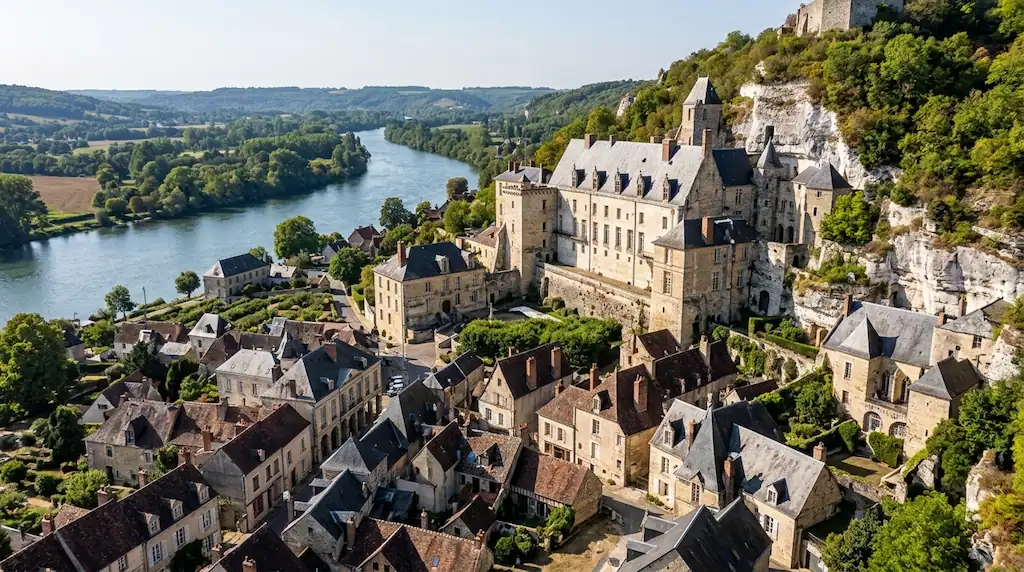
Where Château Meets Cliff in Dramatic Perfection
Some destinations announce themselves gradually, a tower glimpsed through trees, a village emerging around a river bend. La Roche-Guyon does nothing gradually. This extraordinary ensemble, medieval fortress crowning a chalk cliff, château built into the rock face itself, village cascading down to the Seine, hits you with immediate, almost overwhelming visual force.
Located where the Seine carves through limestone cliffs northwest of Paris, La Roche-Guyon combines elements that shouldn’t coexist: troglodyte architecture (rooms literally carved into living rock), classical French château elegance, a “Most Beautiful Village in France” designation, and river valley scenery that painters have immortalized for centuries. This isn’t just another château visit, it’s experiencing how human ambition literally merged with geological drama to create something unique in French heritage.
Among premium destinations, La Roche-Guyon earns its status through sheer visual and historical power that few places can match.
Geography as Destiny
Understanding La Roche-Guyon requires understanding its impossible location. The Seine, carving through the Vexin plateau, created chalk cliffs rising 60 meters above the river. Most civilizations would build villages on gentler terrain. The lords of La Roche-Guyon saw those cliffs and thought: “Let’s build there.”
The result is vertical architecture that defies conventional château design. The medieval keep sits atop the cliff like a geological crown. Below it, carved through solid chalk, a 170-step underground staircase descends through the rock to connect fortress and residence. The main château nestles into the cliff base, its rear literally embedded in stone. Troglodyte stables, storage rooms, and defensive galleries tunnel through the limestone. The village spreads below toward the Seine, houses built partially into the cliff face.
This isn’t architecture adapted to landscape, it’s architecture and geology fused so completely that the château seems to grow from the rock itself.
The Medieval Keep: Sky-High Sentinel
Begin at the top. The 12th-century keep (donjon) occupies the cliff’s summit, accessible via that famous underground staircase or (for those preferring sunlight and views over historical authenticity) exterior paths carved into the rock face.
The Climb
The underground passage through solid chalk is genuinely remarkable, not a tourist addition but the actual medieval passage defenders used. Climbing in semi-darkness, feeling chalk walls worn smooth by eight centuries of footsteps, you experience castle life’s claustrophobic reality. This wasn’t grand staircase, it was emergency escape route and strategic connection between fortress and residence.
Emerging at the summit feels like resurrection, from cramped darkness to explosive light and views.
The Panoramic Reward
From the keep, the Seine valley spreads below in sweeping panorama. The river curves in elegant S-shape, reflecting sky and clouds. Forested hills rise beyond, creating layers of landscape extending to horizon. The village clusters below like model train scenery. The château appears as elaborate roofscape from this aerial perspective.
This view reveals military logic immediately. Controlling this height meant controlling the Seine valley, river traffic, trade routes, and approaches from multiple directions. No army could move unseen through this landscape; the keep’s watchmen commanded everything.
But beyond military strategy, the aesthetic power overwhelms. This is among the most photographed viewpoints in the Île-de-France region, and cameras don’t exaggerate. The combination of cliff, river, forest, and sky creates composition of natural grandeur rarely matched.
The Château: Where Classical Meets Cliff
Descend to the main residence and architectural genre shifts entirely. While the keep represents medieval fortification, the château embodies 18th-century classical elegance, but with geological twist.
The Dual Identity
The front façade presents conventional château architecture: symmetrical design, classical proportions, formal entrance courtyard, the refined aesthetic of aristocratic French residences. You could be at any elegant country house.
Then you see the rear. The building literally disappears into the cliff. Windows illuminate rooms carved from living rock. The chalk face rises vertically behind the building like geological wall. Troglodyte galleries tunnel sideways into stone. Architecture becomes cave-dwelling made elegant.
This duality, polished façade facing the world, primitive rock-dwelling behind, creates unsettling but fascinating effect. The château simultaneously performs civilization and embraces geological reality.
The Distinguished Residents
La Roche-Guyon’s history reads like French aristocratic who’s-who. The La Rochefoucauld family owned the château for centuries, producing writers, politicians, and military leaders who shaped French culture.
François de La Rochefoucauld, the 17th-century moralist who wrote the immortal Maximes, knew these halls. His cynical, psychologically penetrating observations about human nature were refined in salons held here. Walking rooms he inhabited connects you to literary genius whose insights remain devastatingly accurate four centuries later.
During World War II, German Field Marshal Rommel established headquarters here, directing Atlantic Wall defenses from this château. The underground galleries served military purposes again, now housing command centers rather than medieval garrisons. This dark chapter adds historical weight, the château witnessed not just aristocratic elegance but 20th-century warfare’s strategic planning.
Interior Splendors
The State Apartments showcase 18th-century aristocratic taste: painted ceilings, period furniture, tapestries, and art collections displaying refined aesthetic sensibility. These aren’t Versailles-level opulence, they’re more intimate, human-scaled luxury appropriate to country residence rather than royal palace.
The Grand Salon features beautiful painted panels and maintains original furnishings, allowing visitors to imagine social life here: salons where intellectuals debated, musical evenings, intimate gatherings of France’s cultural elite.
The library houses impressive collection reflecting the La Rochefoucauld family’s intellectual interests. Books line walls floor-to-ceiling, creating that particularly aristocratic atmosphere where learning, leisure, and status intertwined.
But the most unusual spaces are the troglodyte rooms, chambers carved entirely from chalk, their walls bearing chisel marks from medieval excavation. Some served as stables (cool temperatures ideal for horses), others as storage (limestone’s constant temperature perfect for wine and food preservation), still others as defensive positions during sieges.
The Village: Medieval Perfection on the Seine
Beyond château walls, La Roche-Guyon village earned designation as one of France’s Most Beautiful Villages (Plus Beaux Villages de France), a title requiring rigorous standards of architectural preservation, aesthetic quality, and authentic character.
Troglodyte Architecture Throughout
The village doesn’t just sit near cliffs, it inhabits them. Houses built into the rock face use the chalk as rear wall, creating hybrid structures half-built, half-excavated. Cave dwellings tunneled through limestone served as homes for centuries, maintaining constant temperature that required minimal heating in winter, stayed cool in summer.
Walking village streets, you constantly encounter this geological intimacy: a conventional house whose back rooms disappear into cliff, a garage that’s actually a cave, storage cellars extending deep into chalk, entire blocks where architecture and geology merge.
This isn’t preservation of historical oddity, people still live in these troglodyte structures, maintaining traditions centuries old while adding modern amenities. Skylights illuminate formerly dark chambers. Doors carved through rock open to reveal contemporary interiors. Ancient and modern coexist naturally.
The Church
The Collegiate Church of Saint-Samson, dating to the 12th century, anchors the village spiritually and architecturally. Built partially into the cliff, it continues the theme of architecture embracing geology. The interior’s Romanesque simplicity contrasts with château elegance, representing village faith versus aristocratic culture.
The church contains several La Rochefoucauld family tombs, connecting village spiritual life to château secular power across centuries.
Riverside Charm
The village descends to Seine riverbanks where stone quays and boat landings recall when river commerce sustained communities. Today these waterfront areas offer peaceful promenades, cafés with river views, and access to walking and cycling paths following the Seine through the valley.
The river here flows broad and calm, reflecting cliffs and village in mirror surface. Swans glide past. Pleasure boats navigate channels. The atmosphere becomes almost Mediterranean, southern France transplanted to Norman valley.
The Gardens: Potager and Terraces
The château’s formal potager (kitchen garden) demonstrates 18th-century garden design meeting practical food production. Geometric beds grow vegetables, herbs, and flowers in artistic arrangements where utility and beauty merge.
This wasn’t mere decoration, these gardens fed château residents and staff. The design philosophy holds that food production deserves aesthetic consideration equal to purely ornamental plantings. French culture’s integration of daily life and beauty manifests perfectly here.
Terraced gardens cascade down the cliff face in levels, creating outdoor rooms with different characters. Upper terraces offer château views; lower levels provide river panoramas. The design manages steep terrain elegantly, turning topographic challenge into architectural advantage.
Walking these terraces, you experience layered perspectives: looking up to the keep crowning the cliff, looking down to village and Seine spreading below, looking outward to valley vistas. The vertical geography creates constantly shifting viewpoints impossible in flat landscapes.
Why La Roche-Guyon Demands Premium Status
Among supplemental destinations, what elevates La Roche-Guyon to premium tier alongside Giverny?
Visual drama unmatched by other châteaux: Versailles impresses through scale, Dampierre through proportion, Breteuil through fairy-tale charm. La Roche-Guyon staggers through sheer geological theater, architecture defying gravity, history carved through solid rock, village and river creating composition of almost excessive beauty.
Unique architectural typology: No other major French château integrates troglodyte elements so completely. This isn’t fortress adapted to hill, it’s human habitation merged with cliff face across centuries.
Layered historical significance: Medieval fortress, Renaissance residence, Enlightenment intellectual salon, WWII military headquarters, La Roche-Guyon witnessed and shaped French history across nearly a millennium.
The Seine valley setting: River landscapes possess romantic power that even spectacular châteaux in land-locked valleys cannot match. Water doubles beauty through reflection, creates light effects impossible elsewhere, and adds navigation history to architectural heritage.
“Plus Beaux Villages” designation: This official recognition confirms what eyes immediately see, extraordinary preservation of integrated château-village ensemble rare in French heritage.
Distance and effort: Like Giverny, La Roche-Guyon requires significant travel from the Vallée de Chevreuse. The journey commits resources justifiable only for destinations offering experiences unavailable closer.
For these reasons, La Roche-Guyon earns its premium position, not merely another château, but a destination offering genuinely unique combination of elements impossible to experience elsewhere.