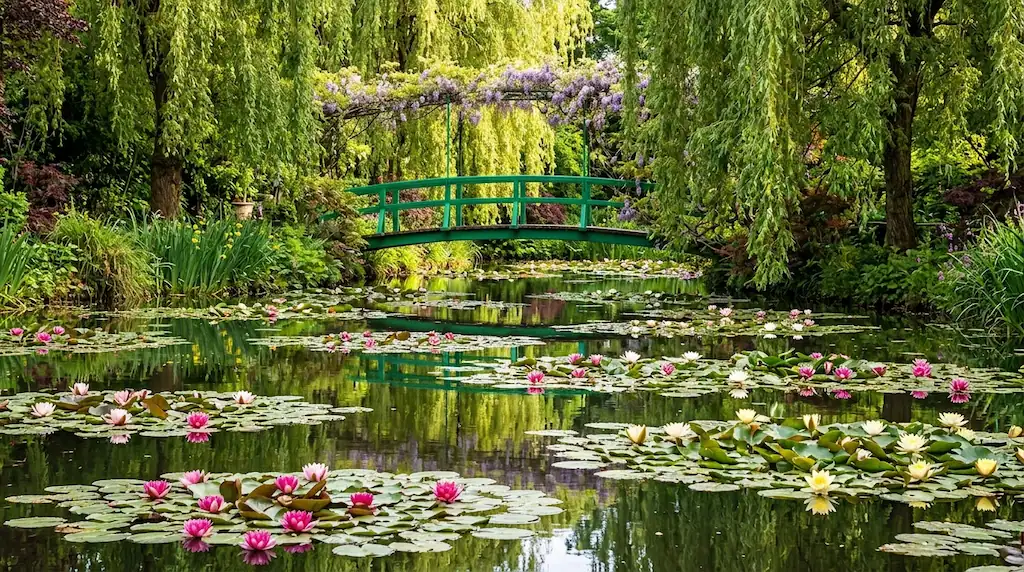
Some destinations transcend tourism to become pilgrimage. Giverny, Claude Monet’s home for forty-three years, is such a place. Here, in gardens he designed as living paintings, beside a pond he transformed into his obsession, one of history’s greatest artists created the works that revolutionized how humanity sees light, color, and nature itself.
The Water Lilies, the Japanese Bridge, the explosions of color that defined Impressionism’s final evolution, all came from this Norman village an hour northwest of Paris. Visiting Giverny isn’t just seeing where a famous artist lived. It’s stepping into the three-dimensional source of paintings that hang in museums worldwide, understanding how landscape became art, and witnessing what happens when genius meets nature and refuses to separate them.
Why Giverny Commands Premium Status
Among the valley châteaux and local destinations, Giverny stands apart, hence its designation as a premium destination requiring supplement. Several factors justify this distinction:
Distance: Giverny lies roughly 80 kilometers from the Vallée de Chevreuse, requiring significant travel time that shorter local excursions don’t demand.
International significance: While Château de Breteuil charms and Dampierre impresses, Giverny draws art lovers from every continent. Monet’s influence transcends French culture, his work fundamentally changed global art.
Crowd management: Giverny’s fame creates visitor volume requiring advanced planning, timed entry, and strategic timing that local destinations don’t need.
Extended visit: The gardens demand hours to experience properly across seasons, changing light, and contemplative appreciation that casual touring cannot provide.
Cultural weight: This isn’t another beautiful French destination, it’s where modern art history was literally painted. That significance warrants premium recognition.
For visitors making the journey, Giverny delivers experiences impossible elsewhere. This is where you understand Impressionism not as museum artifact but as living vision still unfolding in gardens blooming exactly as Monet designed them.
The Artist and His Eden
In 1883, Claude Monet discovered Giverny from a train window. Already an established Impressionist, he was searching for landscape that would feed his evolving artistic vision. The Norman countryside, gentle hills, the Epte River, soft light filtered through atmospheric moisture, captured him immediately.
He rented a house with land, then purchased it in 1890, beginning the transformation that would occupy the rest of his life. Monet didn’t just paint gardens, he created them as three-dimensional compositions, living artworks he could inhabit, observe obsessively, and translate onto canvas.
This distinction matters profoundly. Giverny’s gardens aren’t historical accident or natural beauty Monet happened upon, they’re deliberate artistic creations designed by a painter who understood color, composition, and light at genius level. Walking these gardens means experiencing landscape as Monet intended viewers to experience his paintings: immersed, surrounded, overwhelmed by sensory beauty.
The Flower Gardens: Explosions of Orchestrated Color
Approach Monet’s house and the Clos Normand gardens announce themselves with force. These aren’t gentle French formal gardens or romantic English landscapes, they’re deliberately wild profusions of color that seem barely controlled, as if nature’s exuberance is constantly threatening to overwhelm human design.
This controlled wildness was Monet’s genius as gardener. He studied how colors interact in nature as intensely as on canvas, understanding that flowers planted en masse create different effects than isolated specimens. He composed in three dimensions and four seasons, orchestrating blooms so color waves would peak sequentially from spring through autumn.
Spring: The Awakening
Early spring brings tulips in massive drifts, not scattered specimens but rivers of color flowing through beds. Monet planted them in complementary and contrasting combinations that make color vibrate: orange against purple, red beside pink, yellow masses that glow like captured sunlight.
Wisteria drapes the Japanese bridge and house, creating purple waterfalls that seem to literally pour color through space. The fragrance becomes almost overwhelming, spring in Giverny engages all senses simultaneously.
Flowering fruit trees, apple, cherry, plum, create clouds of white and pink blossoms against sky. Monet understood how these temporary flowering events created painterly moments, capturing spring’s ephemeral beauty before it vanishes into summer green.
Summer: Peak Abundance
Summer transforms the gardens into what can only be described as color delirium. Every available space explodes with bloom:
Roses climb walls, drape arbors, and mass in beds, not the stiff hybrid teas of formal gardens but looser varieties that bloom profusely and naturally.
Nasturtiums cascade over paths in orange and red torrents. Dahlias provide structural drama with dinner-plate sized blooms. Sunflowers tower overhead, their faces tracking sun across sky exactly as Monet painted them.
The Grande Allée, the central path through the flower garden, becomes a tunnel of color, flowers planted so densely that walking through feels like submersion in living painting. Monet designed this deliberate overwhelming, understanding that beauty can be almost too intense to process.
Autumn: Mellowing Glory
As summer’s fury subsides, autumn brings different palette: asters, dahlias in their prime, Japanese anemones, and the warm tones of changing foliage. The light shifts too, lower sun angles create the golden illumination Monet obsessively captured.
This season perhaps best reveals Monet’s genius as colorist. Autumn’s natural palette, golds, russets, burgundies, fading greens, harmonizes in ways spring’s bright primaries cannot. The gardens become study in tonal subtlety rather than chromatic boldness.
Winter: The Bones Revealed
Giverny closes to visitors in winter, but if you could see the gardens dormant, you’d understand their underlying structure. Monet designed permanent features, paths, arbors, architectural plants, that provide beauty year-round while supporting seasonal explosion.
The Water Garden: Monet’s Final Obsession
Cross under the road from the flower gardens and you enter different world entirely: the water garden where Monet spent his final decades creating the paintings that would define his ultimate legacy.
Creating the Pond
When Monet purchased additional land across the road in 1893, he conceived something unprecedented: transforming a marshy stream into Japanese-inspired water garden that would become his final subject.
Local authorities initially opposed his plan, fearing exotic water plants might poison the water supply. Monet persisted, and by 1895 his pond existed, fed by the Epte’s waters, planted with water lilies he imported and hybridized, crossed by a wooden footbridge inspired by Japanese prints he collected.
This wasn’t landscape gardening, it was creating the subject he would paint obsessively for thirty years. The water garden exists because Monet needed it to exist, because his artistic vision required this specific combination of water, light, reflection, and floating color that nature alone didn’t provide.
The Japanese Bridge
The green wooden bridge arching over the pond’s narrow end is among the world’s most photographed garden features—and for good reason. Monet painted it repeatedly, capturing how wisteria transformed it seasonally from green structure to purple cascade to autumn ochre.
The bridge functions both practically (connecting pond banks) and symbolically (spanning East and West, bridging observation point and observed landscape). Standing on it, you occupy the exact position Monet stood countless times, seeing what he saw, understanding how this viewpoint framed his compositions.
In spring, wisteria covers the bridge completely, creating that iconic purple-draped arch reproduced in a million postcards. The reality exceeds the photographs, the fragrance, the way light filters through blossoms, the living quality no image captures.
The Water Lilies
The pond’s surface carries water lilies (nymphéas) in colors Monet specifically cultivated: white, pink, yellow, and deeper rose. These weren’t decorative afterthoughts, they were the obsession that produced his final masterworks.
From 1899 until his death in 1926, Monet painted water lilies almost exclusively. Not occasionally, hundreds of paintings exploring every variation of light, season, time of day, weather, and atmospheric condition. He built a massive studio specifically to create the monumental water lily panels now installed in Paris’s Orangerie Museum.
Walking around the pond, you understand this obsession viscerally. The surface constantly changes: reflections of sky, clouds, trees, and bridge intermingle with lily pads, flowers, and underwater vegetation. The boundary between real and reflected, solid and liquid, becomes ambiguous. Reality itself seems Impressionist.
Monet recognized that this pond offered infinite subject matter because it never looked the same twice. Light changes constantly. Clouds pass. Breezes ruffle the surface. Seasons transform everything. He could paint the same scene daily for decades and never repeat himself because the scene was never actually the same.
Weeping Willows and Japanese Maples
The pond’s banks carry carefully chosen trees: weeping willows whose branches trail in water, Japanese maples that flame red in autumn, bamboo groves that rustle in breeze creating sound to accompany visual beauty.
These plantings weren’t random, Monet composed in layers: water surface, floating lilies, vertical stems, trees overhead, sky reflection. Every element contributed to the total effect he wanted both to inhabit and to paint.
The willows particularly obsessed him in late life. Several final paintings focus on willows’ distorted reflections in water, abstract compositions that anticipated mid-20th century painting decades before it emerged.
The House: Where Artist Lived
Monet’s pink house with green shutters provides essential context for the gardens. This wasn’t just residence, it was headquarters for horticultural and artistic production that required staff, planning, and resources.
The Yellow Dining Room
Step inside and color assault continues. Monet painted the dining room brilliant yellow—not pale butter but intense chrome yellow that glows like captured sunlight. This wasn’t decoration—it was deliberate chromatic choice by artist obsessed with color’s psychological and perceptual effects.
The room displays Monet’s Japanese print collection, hundreds of prints by Hokusai, Hiroshige, and others that influenced his composition and color use. These prints taught Monet how to flatten space, how to use bold color, how to crop compositions unconventionally. The water garden exists partly because these prints showed him possibilities.
The Blue Sitting Room
Contrast the yellow dining room, the sitting room glows blue, again, not subtle pastel but saturated color Monet mixed personally and had applied to walls. Living in color-saturated spaces wasn’t aesthetic whim—it was perceptual training, maintaining heightened color sensitivity he needed for painting.
The Kitchen
The blue and white tiled kitchen with copper pots and period stove shows the domestic reality supporting artistic production. Monet employed cooks, maids, and gardeners, creating beauty at Giverny scale required staff and organization, not just genius.
The Studio
Monet’s large studio (now the gift shop) housed the massive water lily panels. Imagine: walls covered with canvases in progress, light flooding through enormous windows, the artist moving between paintings applying touches that would require months or years to complete.
He worked on multiple canvases simultaneously, moving between them as light conditions changed, building up surfaces through patient layering. This studio was factory of beauty, producing work at industrial scale but handcrafted quality.
Photography and the Giverny Challenge
Every visitor wants photographs capturing Giverny’s beauty. This creates interesting challenge: how do you photograph what’s already been photographed millions of times and create something personal rather than cliché reproduction?
Strategies for Meaningful Photography
Focus on details rather than iconic views: a single lily, water droplets on petals, abstract reflections, color combinations in flower beds.
Embrace imperfection: Crowds in the frame, less-than-perfect light, slightly messy compositions—these create authentic documents rather than Instagram fantasies.
Study Monet’s paintings first: Understanding his compositions helps you see as he saw, finding angles and combinations he recognized as painterly.
Visit multiple times of day if possible: Morning light differs dramatically from afternoon, creating entirely different gardens.
Seasonal variation: Spring tulips, summer roses, autumn dahlias, each season offers completely different photographic material.
Shoot reflections: The water garden’s mirror surface provides endless abstract compositions.
The paradox: Giverny’s most famous views, the Japanese bridge draped in wisteria, the water lily pond, are so photographically documented that original vision becomes nearly impossible. Yet experiencing them in person transcends photography because you inhabit them rather than frame them, experiencing sensory totality no photograph captures.
Managing Crowds and Maximizing Experience
Giverny’s popularity creates challenges requiring strategic planning:
Timing Strategies
Early spring (late March-April): Fewer visitors, tulips spectacular, wisteria beginning. Gardens still establishing but already beautiful.
Late spring (May): Peak bloom, peak crowds. If you can handle people, this offers maximum floral display.
Early summer (June): Roses peak, water lilies begin blooming heavily. Still crowded but slightly less than May.
Mid-summer (July-August): Hot, very crowded, but gardens in full abundance. Early morning or late afternoon essential.
Autumn (September-October): Crowds thin, dahlias spectacular, light golden, atmosphere mellower. Underrated season.
Time of Day
Opening time (9:30 AM): First visitors get temporary solitude. The Japanese bridge without crowds is possible only in this window.
Midday (11 AM-2 PM): Peak crowds. Avoid if possible or accept photography will include many people.
Late afternoon (4-6 PM): Crowds thin, light becomes golden, atmosphere relaxes. Excellent timing if schedule allows.
Strategic Touring
Start with water garden: Most visitors go to flower garden first. Reverse this for temporary quiet at the pond.
Circle back: Gardens reveal different qualities as you return to areas previously seen. Repeated viewing deepens experience.
Find quiet corners: Not everywhere is equally crowded. Side paths, secondary viewpoints, garden edges offer escape.
Embrace the crowd: Sometimes accepting that this is shared pilgrimage rather than private discovery creates better experience than fighting for solitude that won’t come.
Why Giverny Justifies the Journey
After châteaux and medieval villages, why travel 80 kilometers to see gardens?
Because these aren’t gardens, they’re source code for modern art. The paintings hanging in museums worldwide came from these beds, this pond, this light. Experiencing Giverny means understanding Impressionism’s origins not intellectually but sensorially.
Because Monet’s genius as gardener rivals his genius as painter. Creating living three-dimensional compositions that work across seasons, times of day, and decades demonstrates artistic vision few possess.
Because beauty at this intensity is rare. Giverny overwhelms. You can become satiated on color, drunk on flower-fragrance, dizzy from visual richness. This intensity, deliberately designed and carefully maintained, creates experiences few places offer.
Because pilgrimage matters. Art lovers journey to Giverny as religious pilgrims visit shrines. Standing where Monet stood, seeing what he saw (garden maintenance ensures continuity), connects you to creative genius across time. This connection transcends tourism to become something more meaningful.
Because you’ll never see his paintings the same way again. After Giverny, viewing Monet in museums means remembering: “I stood there. I saw that light. I smelled those flowers. I understand what he was trying to capture.” The paintings gain depth, dimension, and poignancy they lacked before.
Practical Wisdom
- Book timed entry tickets online: Advance purchase essential April-October
- Arrive at opening: First hour offers best experience
- Allow 2-3 hours minimum: Rushing Giverny is aesthetic crime
- Visit Museum of Impressionism next door: Excellent exhibitions contextualizing Monet and followers
- Eat in Giverny village: Several good restaurants, though prices reflect tourist traffic
- Consider guided tours: Good guides illuminate what independent visitors might miss
- Check bloom status: The foundation’s website updates seasonal conditions
- Closed November-March: Gardens dormant, house closed
The Giverny Effect
Visitors often report unexpected emotional responses to Giverny. Tears aren’t uncommon, whether from beauty’s intensity, artistic genius recognition, or simply overwhelm at experiencing something so deliberately, carefully, lovingly created.
This emotional power comes from Monet’s total vision. He didn’t just paint nature, he created it, lived in it, painted it, then refined both garden and paintings in endless feedback loop. The result is art and life merged so completely that separation becomes meaningless.
You’re not viewing Monet’s subject matter, you’re inside his mind, experiencing how he saw, what moved him, why he devoted decades to water, light, and floating color. This intimacy with genius consciousness creates profound experiences mere sightseeing cannot approach.
Beyond Giverny: The Village
Giverny village itself deserves exploration beyond the gardens. Narrow streets, Norman houses, the church where Monet is buried (simple grave marked only with family name), and several small museums exploring Impressionism’s legacy.
The Museum of Impressionisms hosts excellent temporary exhibitions showing Monet in broader artistic context. These shows demonstrate how Impressionism evolved, who influenced whom, and how this revolutionary art movement continues shaping contemporary vision.
Several artist studios and galleries maintain Giverny’s artistic tradition. While none approach Monet’s genius, the town sustains creative culture that honors its most famous resident.